[22 April update: at the Digital Ethics Lab (OII, University of Oxford) we have elaborated a list of 16 questions to check whether an app is ethically justifiable, the full article, open access, is available here ] There is a lot of talk about apps to deal with the pandemic . Some of the best solutions use the Bluetooth connection of mobile phones to determine the contact between people and therefore the probability of contagion. In theory, it may seem simple. In practice, there are several ethical problems, not only legal and technical ones . To understand them, it is useful to distinguish between the validation and the verification of a system. The validation of a system answers the question: "are we building the right system?". The answer is no if the app is illegal, for example, the use of an app in the EU must comply with the GDPR; mind that this is necessary but not sufficient to make the app also ethically acceptable, see below; is unnecessar...
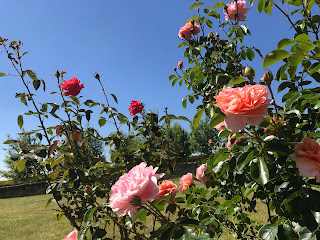
They say that what matters sometimes is not the outcome but the process: not the success or failure of an action, but just the action itself. Maybe. But I always thought it was a bit of sour grapes. Didn’t really want beautiful roses in my garden, kind of line of thinking. The important thing was gardening. Or so you tell yourself, trying to be convincing. But I recite this loudly a few times and it still sounds quite lame. It's the philosopher's fault, because he asks the unpleasant questions. Would you have done it anyway, even if the roses had no chance? But above all, what if the process itself is also pointless? Perhaps the gardening is a failure too, like the dead roses. So you pause, on your way to the roses, and think: if the outcome is not what matters, and the process is not what matters, why caring for the roses? Better stop, or kill the realist awareness that shows the worthless nature of the whole enterprise. Is there anything left, if all is ...
This year, for the first time in its history, the Loebner Prize competition was held in England, at the University of Reading to be precise. It was organised by Kevin Warwick and Huma Shah. Independently of whether Turing might have been pleased (he was not well treated in this country, recall?), there was a satisfying sense of “coming home” of the Turing Test (henceforth TT ). Expectations were high, and they very highly advertised too. The meeting was perfectly organised. Having been invited to play the role of a judge, together with several other colleagues, including two members of the IEG , Mariarosaria Taddeo and Matteo Turilli ( here are their pictures and Rosaria's interview ) , I enjoyed the opportunity to see from close-up the machinery and the TT . It was intriguing and great fun. Because there were interviews with the BBC and other things going on, and because we were also supposed to take part in the parallel AISB Symposium on the TT , I had time to test only...
The art of biting one's own tongue consists in the ability not to engage when someone says something unpleasant, untrue, malicious, or abusive about you. Instead of answering a biased question, arguing against a ludicrous opinion, complaining about an abusive message, correcting a meaningless error, countering a fallacy, explaining a patent mistake, objecting to a groundless criticism, rectifying a willful misrepresentation, rejecting an insinuation, responding to a provocation, retorting to a nasty remark, replying to an offensive allegation, … in short, instead of engaging with your mindless interlocutors you simply ignore them and do absolutely nothing, not even acknowledging that you might have received their communication, not even sharing a “no comment”, just silence. As far as they know, you might have never got the email, read the tweet or the Facebook comment, seen the Instagram picture. If you bite your own tongue appropriately, for them their communication might have nev...
This blog has moved to Medium: https://medium.com/@lfloridi New "notes to myself" will be available only there. I'm also gradually editing and moving the ones you find here to Medium.
Semantic Information and The Network Theory of Account (forthcoming in Synthese ) The article addresses the problem of how semantic information can be upgraded to knowledge. The introductory section explains the technical terminology and the relevant background. Section two argues that, for semantic information to be upgraded to knowledge, it is necessary and sufficient to be embedded in a network of questions and answers that correctly accounts for it. Section three shows that an information flow network of type A fulfils such a requirement, by warranting that the erotetic deficit, characterising the target semantic information t by default, is correctly satisfied by the information flow of correct answers provided by an informational source s . Section four illustrates some of the major advantages of such a Network Theory of Account (NTA) and clears the ground of a few potential difficulties. Section five clarifies why NTA and an informational analysis of knowledge, accord...
"What is life?" is not a question that Pilate asked, but it is as difficult as "what is truth?", so he might. Since Schrödinger's classic , there have been endless attempts at providing a satisfactory answer. The Nishinomiya- Yukawa Memorial International Syposium seeks to provide a multidisciplinary framework to tackle the nature of life in its many forms. It is a very worthwhile project. Some papers will probably be too technical even for a scientifically-minded philosopher (check the program here , you may need to install Japanese fonts). I'm supposed to provide the philosophical contribution, and my talk will be on bioinformation. Schroedinger kepts apologising in his classic for not being a biologist. I shall apologise twice, for not being a physicist (or Schrödinger) either. I hope that my participation will also be a crash course in life-related issues.
Lazy neurons, they fail to see connections even when they are obvious. I cannot recall when I started hearing people talking about the global village , globalisation , hyperconnectivity , spaceship earth , Gaia , ... I grew up with this holistic language as my conceptual koiné . But only recently, thanks to the pandemic, I realised that I should have linked it to another phenomenon: the disappearance of externalities . It is so obvious now. In pseudo-precise literature or pretentious conversations, an externality is a negative effect of a profitable activity, call it a cost, paid by someone else. Like what happens if one runs a profitable business that pollutes someone else's environment. My externalities may be unintended, possibly avoidable, but it is not my problem whether they occur, and the fact that they may occur is not going to stop me from pursuing my activities, since the cost paid by someone else is not a sufficient disincentive to sacrifice my own benefit. ...
Good and bad days make no news and are soon forgotten. But the best or worst moments in you life are memorable, worth mentioning and indeed ranking. The same applies to books and DVDs, restaurants and hotels, sofas and lamps, jokes and quotes. We love ranking because it’s fun and because it takes away the unpleasant doubt that accompanies every daily choice. It’s a mental-energy short-cut that can make you laugh (“what’s the most embarrassing thing Bush ever said?”) or get you through the roundabouts of life more smoothly. “This is the best fridge you can buy for that price” doesn’t get any straighter ( http://www.pricerunner.co.uk/ ). Ranking used to be done with friends in a pub or other social occasions, but the Web is clearly the perfect arena for the ranking aficionados. They can go global, harness whole databases and never miss a niche of interest. Web ranking has transformed the word of mouth to a word of mouse. And with the ease and transparency of the web, there emerges a soci...
Interview by Adele Sarno for HuffPost, the Italian original is here The following English translation is provided by Google, apologies for any imprecision. Luciano Floridi, the digital philosopher, works between Oxford and Bologna, from next summer, he will leave Oxford to direct the Center for Digital Ethics at Yale. He has received the highest honour granted by the Italian Republic: Cavaliere di Gran Croce. According to the Elsevier Scopus database, he is the most cited living philosopher in the world. If today we talk about the "philosophy of information", it is thanks to him, who for 30 years, studied the connections between philosophy and the digital world. Professor Floridi, ChatGPT has been at the centre of the debate, especially these days. Elon Musk and a thousand other experts have written a letter asking for its development to be stopped for six months. In Italy, on the other hand, the privacy guarantor has decided to stop for 20 days until it complies with the pr...
 Received the Vice Chancellor Award 2010


Comments
Post a Comment