[22 April update: at the Digital Ethics Lab (OII, University of Oxford) we have elaborated a list of 16 questions to check whether an app is ethically justifiable, the full article, open access, is available here ] There is a lot of talk about apps to deal with the pandemic . Some of the best solutions use the Bluetooth connection of mobile phones to determine the contact between people and therefore the probability of contagion. In theory, it may seem simple. In practice, there are several ethical problems, not only legal and technical ones . To understand them, it is useful to distinguish between the validation and the verification of a system. The validation of a system answers the question: "are we building the right system?". The answer is no if the app is illegal, for example, the use of an app in the EU must comply with the GDPR; mind that this is necessary but not sufficient to make the app also ethically acceptable, see below; is unnecessar...
This year, for the first time in its history, the Loebner Prize competition was held in England, at the University of Reading to be precise. It was organised by Kevin Warwick and Huma Shah. Independently of whether Turing might have been pleased (he was not well treated in this country, recall?), there was a satisfying sense of “coming home” of the Turing Test (henceforth TT ). Expectations were high, and they very highly advertised too. The meeting was perfectly organised. Having been invited to play the role of a judge, together with several other colleagues, including two members of the IEG , Mariarosaria Taddeo and Matteo Turilli ( here are their pictures and Rosaria's interview ) , I enjoyed the opportunity to see from close-up the machinery and the TT . It was intriguing and great fun. Because there were interviews with the BBC and other things going on, and because we were also supposed to take part in the parallel AISB Symposium on the TT , I had time to test only...
The art of biting one's own tongue consists in the ability not to engage when someone says something unpleasant, untrue, malicious, or abusive about you. Instead of answering a biased question, arguing against a ludicrous opinion, complaining about an abusive message, correcting a meaningless error, countering a fallacy, explaining a patent mistake, objecting to a groundless criticism, rectifying a willful misrepresentation, rejecting an insinuation, responding to a provocation, retorting to a nasty remark, replying to an offensive allegation, … in short, instead of engaging with your mindless interlocutors you simply ignore them and do absolutely nothing, not even acknowledging that you might have received their communication, not even sharing a “no comment”, just silence. As far as they know, you might have never got the email, read the tweet or the Facebook comment, seen the Instagram picture. If you bite your own tongue appropriately, for them their communication might have nev...
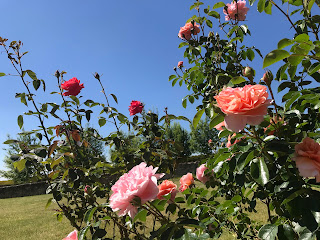
They say that what matters sometimes is not the outcome but the process: not the success or failure of an action, but just the action itself. Maybe. But I always thought it was a bit of sour grapes. Didn’t really want beautiful roses in my garden, kind of line of thinking. The important thing was gardening. Or so you tell yourself, trying to be convincing. But I recite this loudly a few times and it still sounds quite lame. It's the philosopher's fault, because he asks the unpleasant questions. Would you have done it anyway, even if the roses had no chance? But above all, what if the process itself is also pointless? Perhaps the gardening is a failure too, like the dead roses. So you pause, on your way to the roses, and think: if the outcome is not what matters, and the process is not what matters, why caring for the roses? Better stop, or kill the realist awareness that shows the worthless nature of the whole enterprise. Is there anything left, if all is ...
They say that to call someone pedantic is an insult. I'm not so sure. True, someone pedantic is obsessed with minor details, small errors, or tiny imperfections. And a pedantic is also someone who cares too much about all such things not to let you know about them, advising or correcting, disagreeing or disapproving. And yes, if you are a pedant, you are more than just occasionally pedantic. This can happen to anybody, the excessive emphasis on some narrow or boring detail being a tendency we all share when it comes to matters about which we care very much. But if you are a pedant, being pedantic is your daily stance, your intrinsic nature, your way of living. You are always, consistently, reliably, systematically pedantic, from the moment you wake up, about the exact place where the slippers should be next to your bed, all the way to the moment you go to sleep, and the exact place where the phone should be placed to recharge. If you are a true pedant, no detail is too trivial, no ...
There are people who think they know better, and those who know better than to convince them that they don't. I now belong to the second group, but I regularly meet many members of the first: confident, opinionated, patronising. I know them well. For I was one of them. Their beliefs are not improvable, because they are perfect in their views and unfixable in mine. They don't simply know what the case is. They know better than anyone else what the case really is. And they will tell you, even if you don't ask. Assuming you are not too obtuse, life teaches you the hard way to enrol in the other group, of those who should have known better and now know better than to engage. Mistake after mistake - even if you re-arrange facts with a Herculean effort, even if you resist the pressure of mounting evidence, no matter how self-self-preserving your attitude is (yes, it is the self-preserving nature of the self) - sooner or later should teach you some humbleness. Hammer it home, you...
Some questions are bad. Not because they are stupid. Stupid questions are so because of their content, or context, or implications. Stupid questions can also be bad, of course, but bad questions need not be stupid. Questions are bad because they make you look bad when you answer them. For they are questions badly formulated. They are "loaded". So if you wish to avoid a silly answer, you must be ready to question the question, and this is not only bad manners, it also gives the impression that one is trying to dodge the question . Bad questions seem to be of at least two kinds. Yes or no questions. "So, in the end, and to be clear about what you really think: is true, universal Artificial Intelligence possible or not?". If you say no, you are wrong, because there is a sense in which AI is possible, i.e. it is not logically impossible (a contradiction). But if you say yes, then you are wrong, because true, universal AI, the kind you see in sci-fi movies, is factually ...
This blog has moved to Medium: https://medium.com/@lfloridi New "notes to myself" will be available only there. I'm also gradually editing and moving the ones you find here to Medium.
Ho sempre criticato Berlusconi, i suoi votanti, il suo partito, il berlusconismo, gli italoforzuti, i suoi governi, la tragedia (soprattutto morale, ma anche istituzionale, politica, culturale ed economica) che tutto ciò è stato per il paese... Berlusconi è stato un disastro per l'Italia, una sorta di Trump al potere o vicino al potere per decenni. Servirà moltissimo lavoro e tanto tempo per riparare i danni fatti, ammesso che si possano riparare. Ma Mercoledì 14 Giugno ho spostato la lezione del corso che tengo a Bologna, affinché chi volesse potesse participare ai funerali di stato e commemorare la morte di Berlusconi, e perché l'attuale governo ha proclamato il lutto nazionale per un politico che (con mio scandalo e vergogna) è stato eletto democraticamente da milioni di italiani e italiane (che gli dei dell'Olimpo li perdonino, io non ci riesco, e posso solo rispettarne le scelte), e ha ricoperto la carica di primo ministro quattro volte. Non è stata una forma di risp...
Why does one publish anything at all? In a world that is always distracted. That already has millions of books. That has more classics than anyone will ever be able to read. In a world that does not read, does not care, does not mind. Why, really? If writing were just a dialogue with oneself, there would be no need to make it public. Why involve others in a private struggle? What is this need to share one's own thoughts? Something is wrong. Let me exclude some obvious answers. Of course, there are professional requirements: an academic, for example, will struggle to get a job without publications. There may be commercial needs: hoping to make some money, or just being able to support oneself. Commitments and promises can also play a role. Ambitions of fame and hopes for glory should never be underestimated, no matter how groundless. And with them, the glimpse, or just the illusion of a slice of immortality, or at least of a less short legacy. Someone may read you, one day, in a dis...






Comments
Post a Comment